
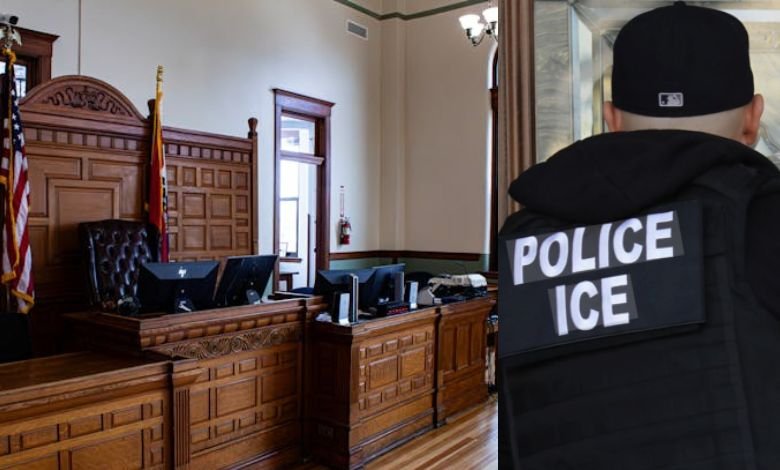
A Federal Judge Blocked ICE from Arresting Immigrants at Courthouses, what means for safety, rights & access to justice!
I remember the first time I heard the news that a federal judge blocked ICE from arresting immigrants at courthouses. It had not passed. A legal journal or a formal report. It was through a conversation. Someone worried, unsure, and quietly asked, “Does that mean it’s safe now?” That question sticks with me. Because behind the headlines and legal jargon, this issue is not just a matter of politics. It’s about real people trying to navigate a system, which suddenly feels unexpected, a perfect example of how principles of Behavioral Law influence human decision-making and perception in legal contexts.
Let’s break it down. A way It actually makes sense.
What Happened?
But its core, The situation is: a federal judge blocked ICE from arresting immigrants at courthouses in certain jurisdictions. Then came the decision legal challenges claimed that these arrests interfered. The justice system itself.
But here’ s This is where it gets interesting and complicated.
The federal government defended himself these arrests By using a legal justification That, below court proceedings, Became problematic. In information, the authorities admitted it. Part of their reasoning did not actually apply. Immigration courthouse Arrests of course. It’s not something you observe. Every day. When the legal foundation starts everything is made to break top of it becomes objectionable.
Why did the Judge Step In?
But on the surface, it seems like a narrow legal decision. But the reasoning behind it goes very deep.
The judges picked up several key Concerns:
- Due process violations: Should be accessible to people. Courts Without fear
- Access to justice: If individuals avoid the court, the system breaks down
- Coercion risk: A court appearance can direct to direct detention
- System integrity: Courts should not act as enforcement traps
One phrase which keeps coming in the bids. “ Hobson’ s choice.” It sounds technical, but the meaning is simple: a situation where there really isn’t any. Good option. Immigrants were forced to choose between attending court and risk arrest, or depart and face court automatic legal consequences.
It isn’t. A fair system. And the courts recognized it.
The Hidden Strategy Behind Courthouse Arrests
Here’s something most articles do not clearly say.
Courthouse The arrests were not random. They were strategic.
Assess of it this way:
- If you aspire to determine someone you can trust, where do you go?
- a they Must be legally present.
- Courts are just that. Predictability, structure and inevitability.
Immigration enforcement agencies use this predictability. Agents will position themselves. Near entrances, Once, or even just outside buildings. Even when restrictions were imposed, enforcement sometimes changed quite simply. Beyond courthouse boundaries.
It’ s Effective, but it also raises serious ethical and legal questions.
Can ICE Still Make Arrests But Courthouses?
This is the question that matters most to people.
And the answer is… It depends.
Though a federal judge blocked ICE from arresting immigrants at courthouses, the ruling is not applicable everywhere. The United States runs under a system where federal district rulings may vary according to region.
So now, the situation It looks something favor this:
- Region Status
- Some federal districts Arrests limited
- Others Still allowed
- Appeals Courts Ongoing decisions
In other words, there isn’t one single rule across the country. This is it. A patchwork. And that uncertainty: Why exactly that? Many people are looking for answers.
What This Means to Immigrants
Let’s take a break. A moment And assess the human side
His Imagine you have. A court date. You have prepared your documents, Probably talked about a lawyer, Probably not You’ re Nervous but hopeful. Now add a new layer: the possibility that showing up can be taken into custody.
That changes everything.
Even with the edicts in the venue, the fear does not disappear overnight. People can still hesitate. Families can still worry. And it may lack a court. Serious consequences, including removal orders.
So until a federal judge blocked ICE from arresting immigrants at courthouses, the real- world impact is more complicated. Safety It’s not just about politics, it’ s approx perception, Confidence and consistency.
The Bigger Legal Battle
This issue is part of something very large.
But its heart, It represents a clash between two branches of government:
- The executive branch, Responsible for implementation immigration laws
- The judicial branch, Responsible for ensuring justice and due process
When courts enter the border enforcement actions, they basically assert: There are limits, me too immigration enforcement.
And this case pushed those boundaries in the spotlight.
What makes it even more unusual is that the government’ s admission that its earlier legal argument An error occurred. That raises bigger questions:
- Were previous arrests justified?
- Could previous cases be challenged?
- What will the politics of the future inspect appreciate?
These are not. Small questions. They have long- term implications.
Data, perception, and Reality
Here’s another team that is often overlooked.
Courthouse The arrests may be affected. Immigration statistics In ways that are not immediately obvious. If people avoid the court out of fear their cases can be solved without proper hearings. It may increase. Removal orders And create the appearance of enforcement efficiency.
But is it really fair?
When results are driven instead of fear. Full legal participation, The data does not specify the whole story. It’s in favor of making a decision. A game where half the players were never shown.
What Happens Next?
If you’ re A simple hope, final answer, I wish I could furnish it to you one. But the reality is still open.
Legal experts Expectation:
- Appeals I higher courts
- New legal arguments from the government
- Additional rulings I other regions
- Possible escalation To the Supreme Court
So though a federal judge blocked ICE from arresting immigrants at courthouses, It isn’t the end of the story. I prefer it. The middle is a long, evolving chapter.
Why This Topic Resonates so deeply.
I’ ll be honest, when I first started digging this issue, I thought that would just be it. Another legal update. A heading, a ruling, A quick explanation.
But the more I study the more I realize how layered it is.
It’ s about the law, yes. But it’ s also about trust. About whether people felt safe engaging with a system designed to deliver justice. Whether the rules are clear, or constantly changing.
And maybe that’s why this keyword continues to gain attention. For when a federal judge blocked ICE from arresting immigrants at courthouses, It just didn’t change a policy. It was revealed. A tension for which it was built. Years.
The Key Takings:
So where does that depart us?
We have an order. That limits enforcement in certain areas. We have a government to adjust its legal strategy. And we have people trying to make it. Sense of it all in real time.
If present. One thing carry, it’ s This:
- clarity matters.
- People just don’t require to understand what is what.
- The law articulates, but how does it work their daily decisions?
Because behind every search, Each heading, and every court ruling, That’s it a simple question:” Am I safe?” And if that question has a distinct consistent answer, such a conversation will continue.
Additional Resources:
- Federal judge blocks ICE from arresting immigrants who show up for court appointments in Northern California: A Northern California federal judge halted ICE arrests at immigration courthouses, ensuring safer access to legal proceedings for immigrants.
- S.F. federal judge orders a stop to ICE courthouse arrests: This ruling stops ICE from arresting immigrants attending court in San Francisco and nearby areas, helping protect due process and attendance at hearings.